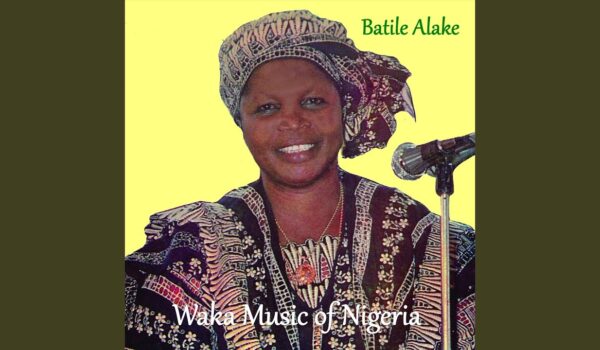
Following the bold step taken by Nigeria’s first female instrumentalist and Waka icon, Batile Alake, to establish herself in a music industry largely dominated by men, she became a source of inspiration for generations of aspiring female musicians seeking to carve out their own place in the highly competitive arena long controlled by their male counterparts.
On May 5, 1961, Salawa Abeni Alidu was born into the family of Pa Alidu and Mama Alidu from Ijebu Waterside in Ogun State. She was born into a polygamous family in a mangrove village near Epe.
Due to her mother’s frequent illness during her childhood and her father, who reportedly did not believe in girls’ formal education, she was sent to live with her mother’s relatives, where she started developing an interest in music. After her father learnt about her interest in music, he disapproved of her singing and feared the tough entertainment industry. To stop her from singing, he intentionally took her from those relatives and sent her to live farther away in Epe, Lagos State, with guardians named Mr. and Mrs. Ganiu Otun.
It was while she was with her father’s relatives that she was sent to work as a housemaid at an early age, not until a local headmaster noticed her and insisted that she be allowed to attend school before she was enrolled into Primary 3 at the age of 13 and finished her education at Primary 6.
After her elementary education in Lagos, circumstances forced her to focus on survival and work at a young age. Unlike many modern musicians who passed through universities and music academies, her true classroom became the streets, ceremonies, and cultural gatherings of Yoruba society where oral traditions flourished.
Her mastery of Yoruba proverbs, chants, praise poetry, and storytelling later became one of the defining features of her music.
Growing up among Islamic chants, traditional ceremonies, and women’s praise-singing groups, she developed a fascination with music while still a child. By the age of ten, she was already singing at local functions and social gatherings around Epe and Lagos. Her remarkable voice often stunned audiences who found it difficult to believe such maturity could come from a little girl.
Her raw talent and melodious voice made people notice her as a gifted child at an early age. Around 1974, when she was 13 years old, a music executive named Lateef Adepoju saw her performing at a social gathering in Lagos. Moved by her raw talent, he negotiated with her parents to sign her to his company, Leader Records.
She released her official debut album in 1976 at age 15, titled Late General Murtala Ramat Mohammed. The tribute album became a massive commercial hit, making her the very first female artist in Nigeria to sell over one million copies.
The album became an unprecedented commercial success, selling over one million copies and making Salawa Abeni the first female Yoruba artiste to achieve such a feat in Nigeria. The record transformed her into a household name and elevated Waka music from a niche genre into mainstream popularity.
Seizing the opportunity of her early stardom, Salawa Abeni established her own live performing band called The Waka Modernisers in 1977.
Read Also: Queen Oladunni Decency: The Woman Who Broke the Strings of Tradition
Salawa Abeni drew inspiration from the pioneers of Waka music, especially female Muslim performers who entertained women during weddings, naming ceremonies, and religious celebrations.
Among the strongest influences on her musical development was the legendary Waka pioneer, Batile Alake, whose innovations laid the foundation for future generations of female indigenous singers. She was also inspired by Yoruba oral traditions, Islamic devotional music, and community praise singing.
Salawa Abeni also brought her own style into the Waka genre by performing at parties while standing, opposing the traditional styles of old musicians who performed while sitting.
As she revealed in some of her interviews, Salawa Abeni was robbed of her royalties on 15 releases from Vol. 1 to Vol. 15 due to her ignorance because of her age at the time.
In the mid-1980s, Salawa Abeni married Fuji legend Ayinla Kollington and subsequently joined his record label after leaving Leader Records.
After her popularity had grown wider, she and her band, The Waka Modernisers, later known as the Waka Funky Modernisers, took traditional Nigerian Waka music to international audiences on several occasions beginning in late 1988. Following her transition to Kollington Records, she released the album Abode America and continued to widen her audience internationally through United Kingdom tours, North American concerts, and many other African countries spanning many decades.
Salawa Abeni’s achievements have earned her numerous honours over the years. Among her most notable recognitions include being crowned “Queen of Waka Music” in 1992 by Lamidi Adeyemi and becoming the first female Yoruba recording artiste to sell over one million copies of an album in Nigeria, alongside many lifetime achievement awards received for her contributions to indigenous music.
For more than five decades in the music industry, Salawa Abeni released more than sixty albums. Some of her notable records include Late General Murtala Ramat Mohammed (1976), Iba Omode Iba Agba (1976), Shooting Stars (1977), Ijamba Motor (1978), Okiki Kan To Sele (1979), Orin Tuntun (1979), Irohin Mecca (1980), Ile Aiye (1980), Omi Yale (1980), Ija O Dara (1981), Ikilo (1981), Abode America (1988), and Ileya Special (1988), amongst others.
In 2008, the life of Salawa Abeni took a difficult turn when she was struck by a severe illness that led to partial paralysis and forced her to step away from music following the sudden demise of her son, Idris Olanrewaju Adepoju, who died in a car accident on the Lagos-Ibadan Expressway on October 2, 2000.
According to her, her condition worsened, and by February 1, 2009, she had become bedridden, beginning a painful health battle that lasted between six and eight years before she eventually recovered and returned to the stage.
The Queen of Waka did not merely sing songs; she opened doors for women in indigenous Nigerian music, redefined what commercial success looked like for female artistes, and carried Yoruba culture across continents.
For generations of Nigerian women in music, Salawa Abeni is proof that talent, determination, and cultural pride can break barriers that society once considered impossible.
Today, the crown still fits only one woman, the undisputed Queen of Waka Music, Salawa Abeni.





Comments