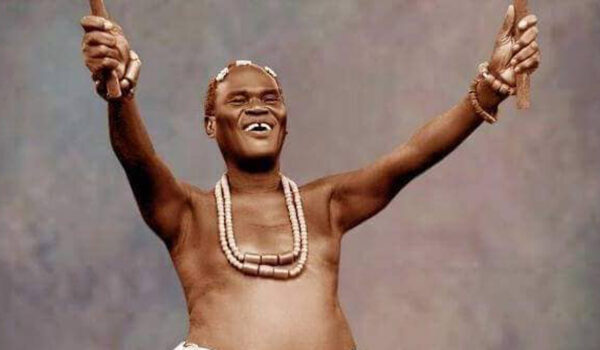
In Nigeria, like any other country, entertainment comes in different forms like music, dance, or drama, through which culture is projected and preserved. Just as the Father of Modern Nigerian Theatre, Hubert Ogunde, contributed to the birth and growth of Nigerian folk opera and its advancement, Kola Ogunmola was one of the early dramatists whose name cannot be overlooked.
Before Ogunmola came onto the scene, Hubert Ogunde, with his troupe, the African Music Research Party, later changed to the Ogunde Concert Party in 1950, had already begun making a name for himself by burying his craft in the hearts of many people through his dedication and determination to propagate Yoruba culture through folk opera and drama.
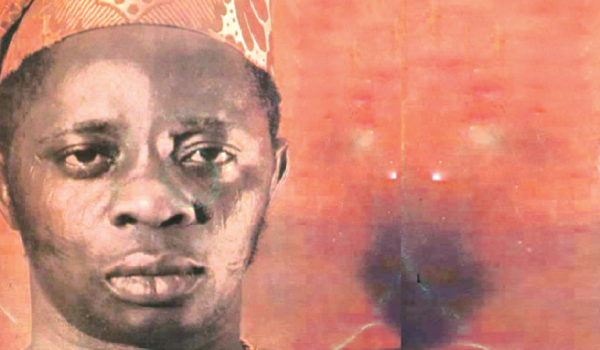
On November 11, 1925, Elijah Kolawole Ogunmola was born into the family of George Ogunmola and Aina Ogunmola in the town of Okemesi-Ekiti. Ogunmola, who was educated, worked as a schoolmaster at Emmanuel Primary School, and some records show that he was also a bandmaster at St. Savior Primary School in Ado-Ekiti, where he led the school band and choir.
While at Emmanuel Primary School, Ogunmola devoted his time to creating school plays performed by pupils within the school and sometimes outside the school premises. With a growing love for the craft, Ogunmola decided in 1948 to form a drama troupe, Ogunmola’s Theatre Party, involving his pupils and fellow teachers, modelled after Ogunde’s Theatre Party.
In the 1950s, Ogunmola’s troupe travelled throughout the western region of Nigeria, performing in schools, churches, and town halls. Although the same plays were often staged, Ogunmola’s productions allowed for improvisational acting on stage, leaving room for the unexpected with each performance. While inspired by Ogunde’s folk opera format, Ogunmola was motivated to refine it. Through his group, he developed Yoruba culture, most importantly folk opera, into a more serious theatre form.
At the time, Ogunmola’s performances were largely staged in the Ekiti region, and he was known as a performer keen on the quality of acting on stage. Most of his early plays were Yoruba folk operas, with drums providing rhythm from the background. He made dancing and the Yoruba language integral parts of his productions.
Read Also: Hubert Ogunde: Doyen of Modern Nigerian Theatre
During his stay in Ekiti, one of his popular plays was Love for Money, the story of a wealthy man who fell for a temptress and, as a result, separated from his wife. However, his relationship with the temptress eventually ruined him.
After several years of acting and the experience he gained from stage performances, Ogunmola relocated from the Ekiti region to Osogbo in the 1950s. While in Osogbo, a German editor and scholar, Ulli Beier, became familiar with Ogunmola’s work. Beier was among the first to recognize that Ogunmola’s productions were more psychologically complex than other folk operas, and he introduced Ogunmola to international critics through his magazine Black Orpheus and the Mbari Club in Ibadan.
Through this relationship, Beier in 1962 lobbied for a Rockefeller Foundation grant, which made Ogunmola the first Artist-in-Residence at the University of Ibadan School of Drama. The grant also provided funds for him to acquire more sophisticated equipment to professionalize his work.
During his period at UI, Ogunmola collaborated with Amos Tutuola and the School of Drama to produce a loose adaptation of The Palm-Wine Drinkard, translated into Yoruba. The production became the university’s flagship cultural export and was also in serious contention with Oba Koso, which eventually became Nigeria’s nominee for the Commonwealth Arts Festival in 1965. In the 1960s, The Palm-Wine Drinkard was honored both in Nigeria and abroad, and Ogunmola’s popularity increased following his six-month residency in Ibadan.
Before his death on January 1, 1973, following a stroke in 1970, Kolawole Ogunmola wrote and produced many plays. These include The Palm-Wine Drinkard (Lanke Omuti), premiered in 1963 and performed at the First Pan-African Cultural Congress in 1969; Ife Owo (Love of Money), first performed around 1950 and published in 1965; Conscience; and Reign of the Mighty. Ogunmola also contributed to early Nigerian television and films such as Asewo To Re Mecca, Ija Ominira, Taiwo Shango, Ijele, and Omo Oloja.
Kolawole Ogunmola’s work, The Palm-Wine Drinkard, received international recognition, representing Nigeria’s excellence at the First Pan-African Cultural Congress in 1969. He was widely regarded by both international and local critics, including Ulli Beier, as the most brilliant actor in Africa during the 1950s and 1960s.
Ogunmola’s legacy lives on, as his dedication and landmark achievements in theatre and film inspired many playwrights, actors, and actresses. Notable among them is his daughter and renowned actress, Peju Ogunmola, who remains active in the theatre world. His son, Yomi Ogunmola, was also a famous Yoruba actor, filmmaker, and director before his death in 2003.





Comments