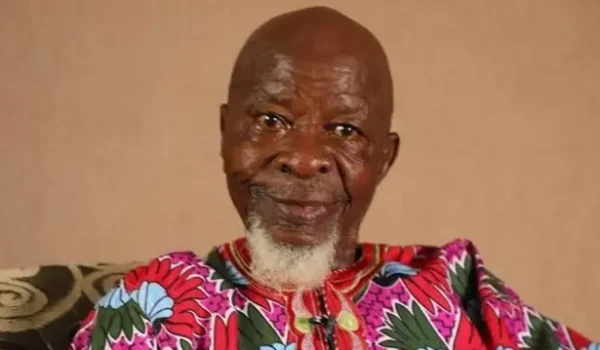
In the Nigerian jùjú & Highlife household, when mentioning names of the music genre’s stars, legends and pathfinders, Olayiwola Fatai Olagunju, who is an invaluable addition to the music circus because of the indelible contributions he brought to the music scene, must definitely come to mind.
Fatai Rolling Dollar was born in 1927 in Isale Eko, Lagos Island, into the family of Chief Olagunju, a native of Ede, Osun State. Olayiwola Fatai Olagunju got nicknamed ‘Fatai Rolling Dollar’ by his schoolmates at the age of nine, owing to his habit of carrying around two shillings which his father would give him to spend on his brother and sister during the period his driving job took him to Ghana.
In 1944, Fatai Rolling Dollar left school following the demise of his father and started a new trade as a sign writer but soon lost interest in it and decided on a career in music, despite parents barring their children from pursuing such.
In the late 1940s, Fatai started his musical journey as a percussionist with Konkoma Bands that were already popular but later began playing Agidigbo in Willie Payne’s band after his previous Konkoma Band folded up. From his new band, Fatai Rolling Dollar joined Julius Oredola Araba‘s band in 1953. For his undivided love for music and passion of becoming one of the established names in the music realm, in 1955, he started developing interest in playing guitar.
Due to his proficient play of guitar and his self-eulogy ‘Seriki Oni Guitar’, one would think Fatai Rolling Dollar learnt his guitar skills from the widely revered and most influential electric guitarist in history, Jimi Hendrix, without knowing that Fatai Rolling Dollar was mainly a self-taught guitarist who developed his skills by reading and following guitar instructional manuals, further developing his playing skills by collaboration and cultural exchange.
In J.O Araba’s Band, “Rhythm Blues”, Fatai Rolling Dollar contributed immensely to the development of the Juju and Highlife genres with his skills in guitar and his vocal ability. In 1956, Fatai Rolling Dollar, who was still with Speedy Araba (J.O Araba), performed at the event held at Odan, now Race Course, organized for then Queen Elizabeth II during her tour to Nigeria and also played at the Grand Opening Ceremony of the Western Nigeria Television, W.N.T.V. Ibadan, and Nigerian Television Authority, N.T.A. 10 Lagos, both in 1960 and 1962 respectively.
Read More: J.O Araba: A Game-Changer in Juju, Highlife Music
During his time in the Afro Skittles, he played vital roles as a guitarist in some of the recordings of Speedy Araba such as Easy Motion Tourist, K’elegbe M’egbe, Turaka, Money Love, Baby Awa, among other wonderful recordings the group had with unmentioned numerous stage performances.
In 1957, Fatai Rolling Dollar left the Afro Skittles Band to form his own, Fatai Rolling Dollar & His African Rhythm Band, and he established the band alongside his friend Seni Tejuoso and began recording for Phillips West Africa Records. During this period, the Juju legend, Chief Ebenezer Obey, was a member who was interning under him. Obey was under the tutelage of Fatai Rolling Dollar before he formed his own group in the late 1960s.
While he was recording for Phillips West Africa Records, his group was booked to perform at the independence celebrations in 1960.
In 1977, a life-threatening phase in the life of Fatai Rolling Dollar began when his residence, which was close to Kalakuta Republic of Fela Anikulapo-Kuti, the late legendary Afrobeat and Jazz lord, got razed as a result of the military invasion of the self-proclaimed republic. Unfortunately, Fatai Rolling Dollars lost his nascent family alongside all his musical instrument to the inferno that gulfed the entire area.
Although the incident was so devastating that Fatai Rolling Dollar could barely fend for himself, his survival instinct made him work as a security officer for about six years where he played his instrument to keep himself engaged.
Through his trying times, the erstwhile boss of great musicians like Ebenezer Obey, late Dr. Orlando Owoh, Bob Aladeniyi amongst others, remained true to his passion. Fatai’s gloomy life became obscure as he resided in a small room in Mushin, Lagos State. Despite his love and unquenchable passion for music, Fatai remained unknown for years until in 2009 when he met Kunle Tejuosho, the in-house producer of Jazzhole Records through Duro Ikujenyo. Their subsequent meeting was the second chance that Fatai Rolling Dollar’s career needed to produce a record, Won kere si number wa, which would re-introduce him to the world.
Since the production of “Won kere si number wa”, Fatai Rolling Dollar became became even greater than he was before misfortune, to the point that he was placed in spots at French Centre before travelling to Morocco, France, Germany, United Kingdom and other foreign places. He thereafter became brand ambassador for several top brands. The Lagos State Government gave him a house in one of the low-cost housing estates in New Oko Oba, Lagos.
The ‘Won kere si number wa’ crooner actively collaborated with his own generation of musicians and young contemporaries like the delectable Yinka Davies, Niyi Ajileye, Aduke Aladekomo among others.
Olayiwola Fatai Olagunju passed away on June 12, 2013, in Lagos at the age of 85 and holds the record of being Nigeria’s oldest practicing musician in history.
Fatai Rolling Dollar was not just a great musician who tutored other musicians, but also remains an inspiration and lesson to everyone that indeed, life presents second chances and failure is not necessarily final.

Comments