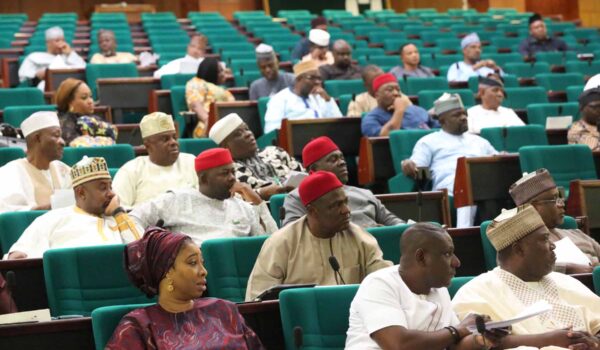
The House of Representatives on Thursday opened debates on a landmark bill seeking sweeping amendments to the Central Bank of Nigeria, CBN Act, in a move aimed at tightening governance, enhancing transparency, and improving oversight of the apex bank.
The bill co-sponsored by House Leader Julius Ihonvbere and Jesse Onakalausi sailed through second reading without opposition.
Titled “A Bill for an Act to Amend the Central Bank of Nigeria Act, 1991… and for Other Matters Connected Therewith, 2025,” the proposal responds to growing public concern over gaps in the CBN’s regulatory and governance framework.
These concerns intensified following controversies around monetary policy, foreign exchange management, and the 2022 currency redesign.
Leading the debate, Onakalausi argued that recent economic challenges have exposed structural flaws in the existing Act.
“The CBN plays a central role in stabilising the financial system, ensuring monetary credibility, safeguarding price stability, and promoting public confidence in the Nigerian economy,” he said.
According to him, governance lapses, FX market distortions, inconsistent monetary policy, and weak oversight mechanisms have made reforms not only timely but necessary.
A key change proposed is the separation of the roles of the CBN Governor and the Chairman of the Board positions currently held by one individual.
In most jurisdictions, Onakalausi noted, central bank governors manage day-to-day operations while a separate board provides oversight. Merging both roles, he argued, concentrates too much power and undermines institutional checks and balances.
The bill also seeks to strengthen the Monetary Policy Committee, MPC, enhance the bank’s independence, and align Nigeria’s monetary governance practices with global standards in the UK, South Africa, Brazil, and the EU.
READ ALSO:
CBN Lifts Cash Deposit Limit, Raises Weekly Withdrawal Threshold To N500,000
The proposed reconstituted MPC will include the governor, four deputy governors, two board members, and four external experts who must be independent and barred from holding public office.
One of the most consequential reforms targets the often-criticised Ways and Means provision the mechanism through which the CBN lends to the federal government.
Onakalausi described it as “one of the most abused provisions” of the Act.
The amendment caps Ways and Means advances at 10% of the previous year’s actual revenue, a move meant to curb inflationary deficit financing and enforce fiscal discipline.
The bill also mandates that two deputy governors must be appointed from within the institution’s director cadre to ensure continuity and reduce political interference.
The amendments propose a single, non-renewable six-year term for the CBN Governor and Deputy Governors.
Source: Punch








Comments